FinSight AI
Short-term stock-movement classification fusing market indicators, financial-news sentiment, and document retrieval.
- Python
- PyTorch
- FinBERT
- Transformers
- RAG
- scikit-learn
- Metric shown
- SHAP explainability
- Reproducible pipeline
- Docker included
- CI/tests included
At a glance
- Problem
- Can short-term stock direction be predicted using market data, news sentiment and retrieved document context?
- Built
- End-to-end financial ML pipeline with technical indicators, FinBERT sentiment and document retrieval.
- Models / methods
- Logistic regression, random forest, gradient boosting, LSTM, GRU and Transformer-style models.
- Result
- Models performed only slightly above baseline, showing the difficulty of short-horizon prediction.
- Strength shown
- Leakage-free evaluation, reproducible experiments, honest reporting.
- Links
- DashboardCase StudyRepo available on request
Visual proof
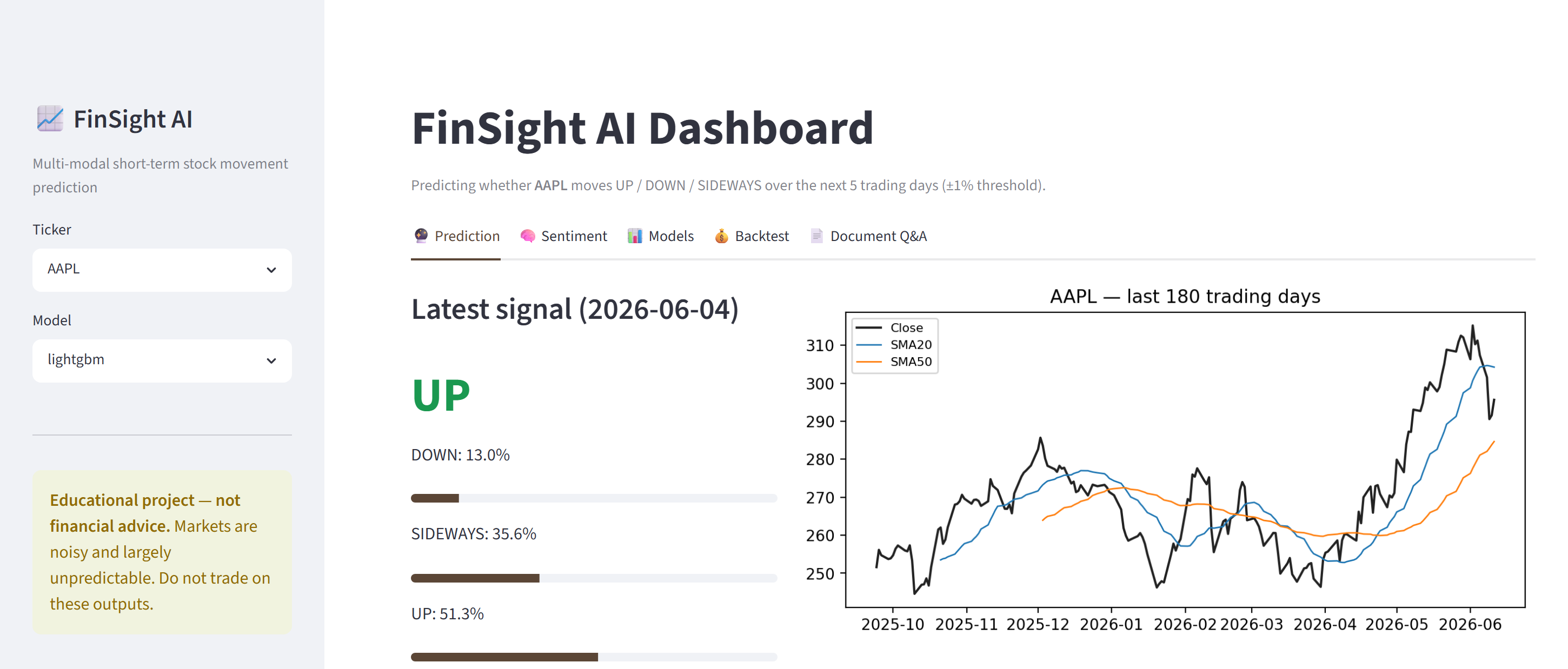
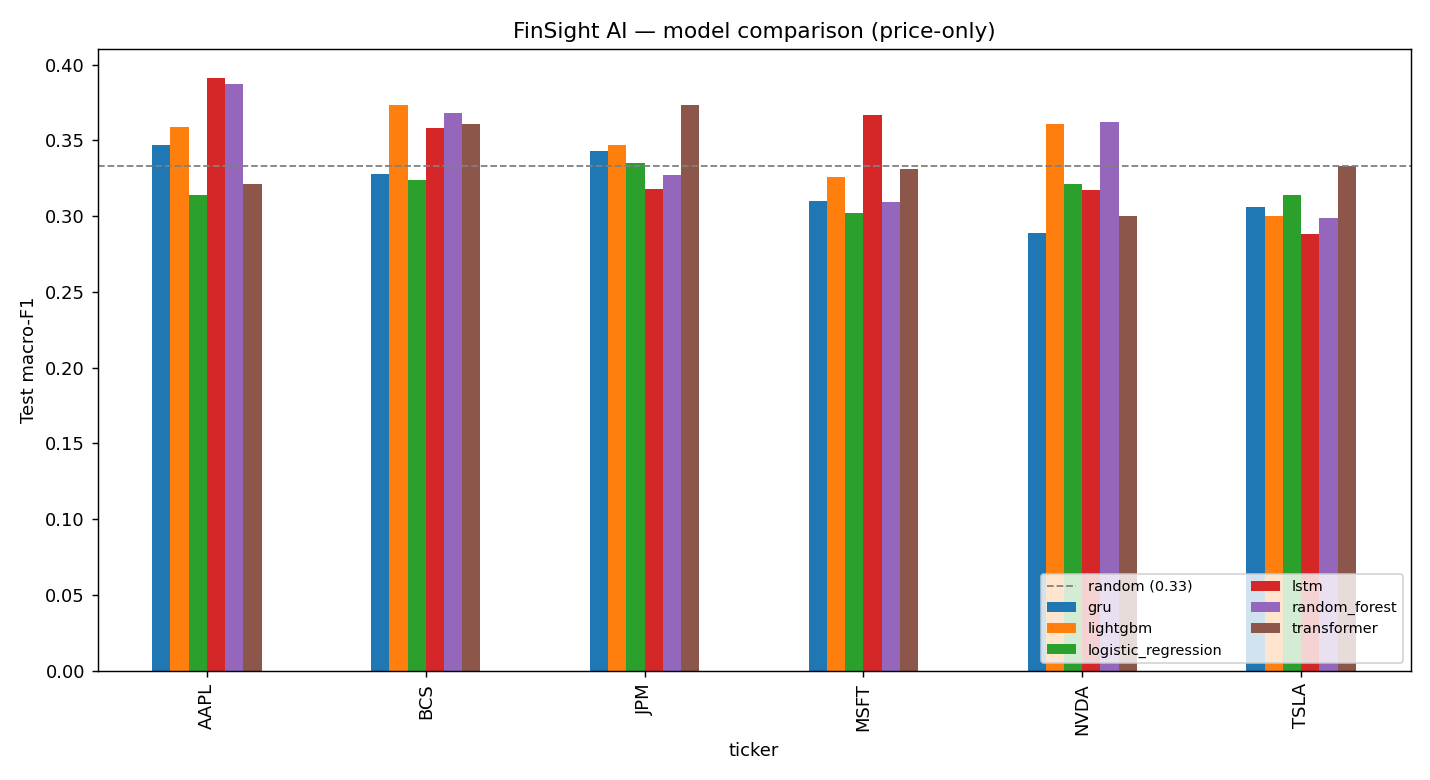
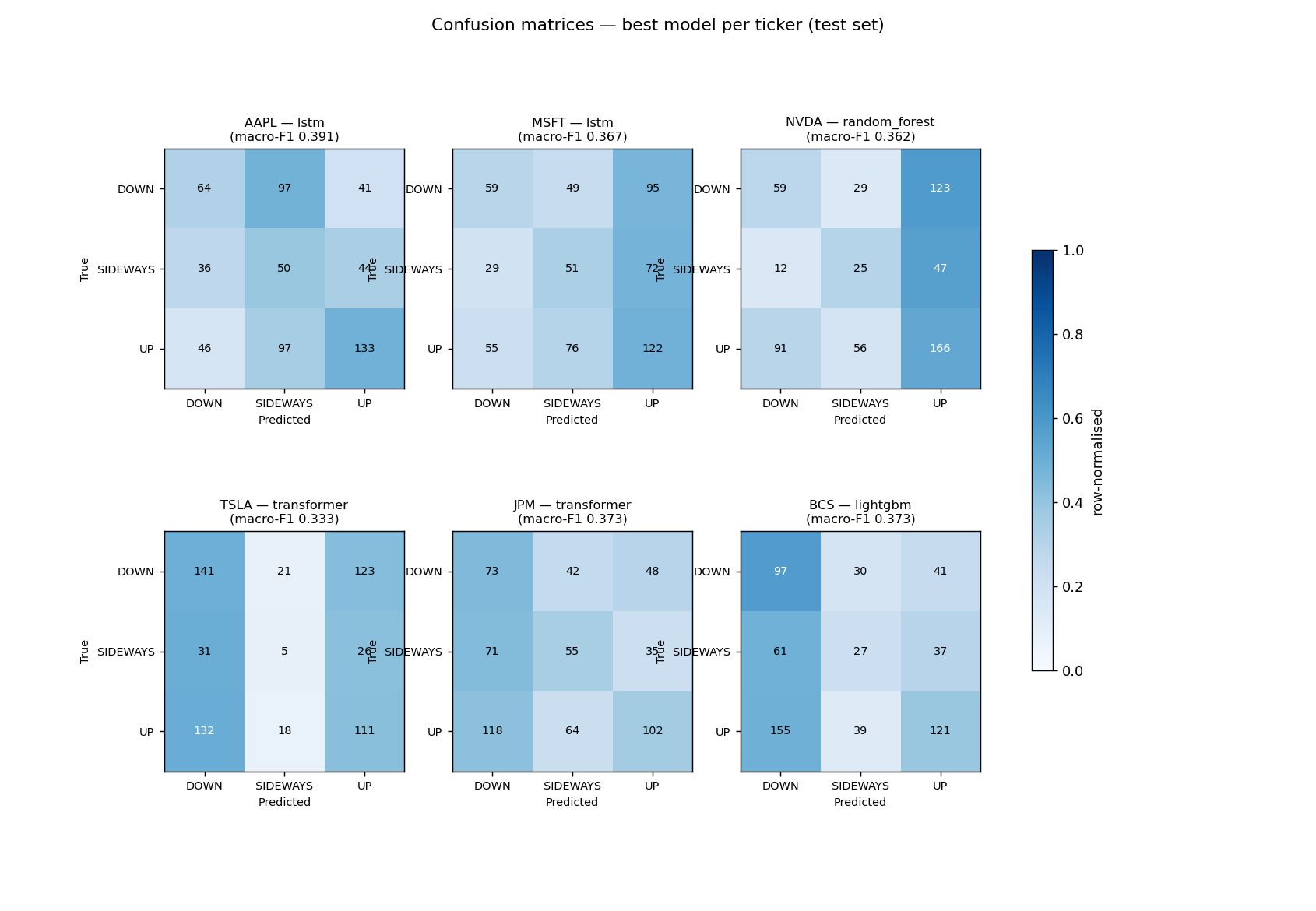
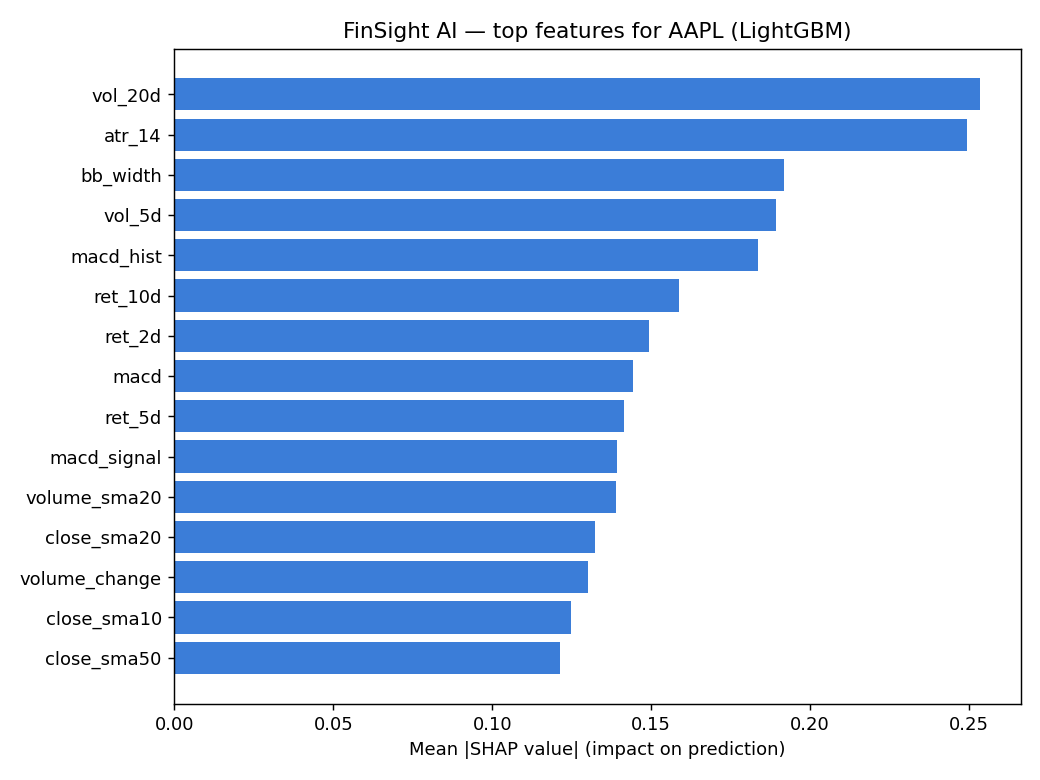
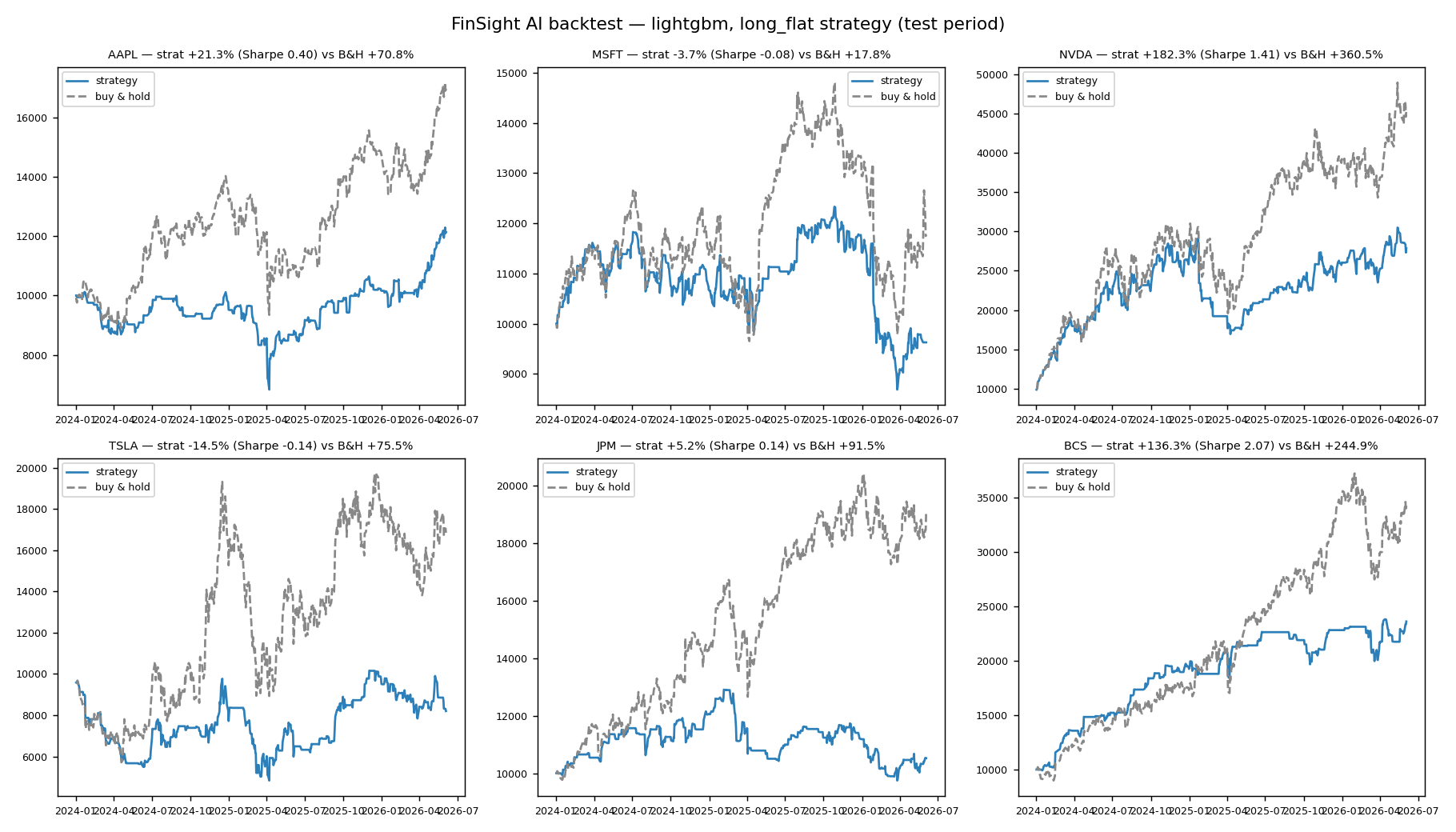
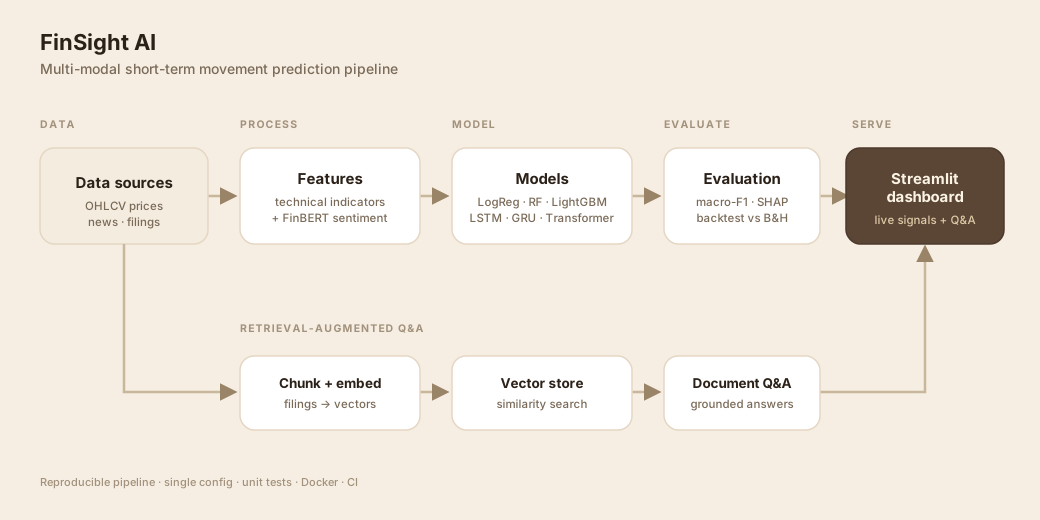
Charts and diagrams are real outputs and architecture from the project.
01Objective
Predict whether a stock moves UP, DOWN, or SIDEWAYS over the next few trading days, and test honestly whether news sentiment and document context improve on price-only models.
02Dataset / input
- Daily OHLCV price history for a basket of large-cap tickers
- Engineered technical indicators (returns, moving averages, RSI, MACD, volatility)
- Financial-news headlines scored for sentiment with FinBERT
- Filings and reports indexed for retrieval-augmented context
03Model approach
- Framed as a 3-class problem with strict, leakage-free time-based splits
- Classical baselines: logistic regression, random forest, gradient boosting
- Deep sequence models: LSTM, GRU and a Transformer-style encoder
- Ablations to isolate the contribution of sentiment and retrieval
04Results / metrics
Evaluated with macro-F1 to respect class imbalance. Models clustered just above the random baseline (0.33) — the honest finding that 5-day direction is close to unpredictable on this universe. SHAP confirmed the models leaned on volatility and momentum signals rather than artefacts.
05Deployment / reproducibility
Packaged as a modular pipeline with a single config, unit tests, a Streamlit dashboard, a Dockerfile, and CI — so every experiment is reproducible end to end.
06Limitations
- Short-horizon market direction is inherently noisy and near-random
- Sentiment used a reproducible sample feed rather than a paid dated archive
- Single market, daily resolution, a handful of tickers
07Future improvements
- Sector-specific market context and a real dated news API
- Walk-forward cross-validation and probability calibration
- A FastAPI inference service alongside the dashboard
08Key takeaway
A negative result, reported honestly: the engineering rigour (leakage-free splits, ablations, reproducibility) matters more than chasing an inflated score on a near-random problem.