House Price Prediction
Regression models that estimate property prices and quantify the drivers of valuation.
- scikit-learn
- pandas
- SHAP
- Matplotlib
- Python
- GitHub available
- SHAP explainability
- Cross-validated
- Reproducible notebook
At a glance
- Problem
- How accurately can property prices be predicted, and which features drive valuation?
- Built
- An EDA-to-modelling regression pipeline with cross-validated model comparison and SHAP.
- Models / methods
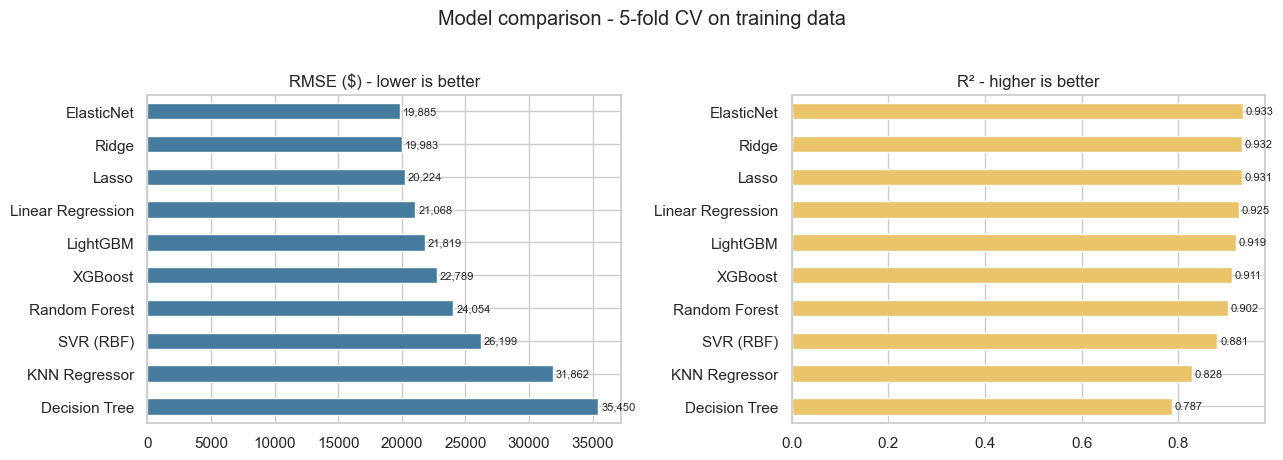
- Linear, tree-based and gradient-boosting regressors compared with 5-fold CV.
- Result
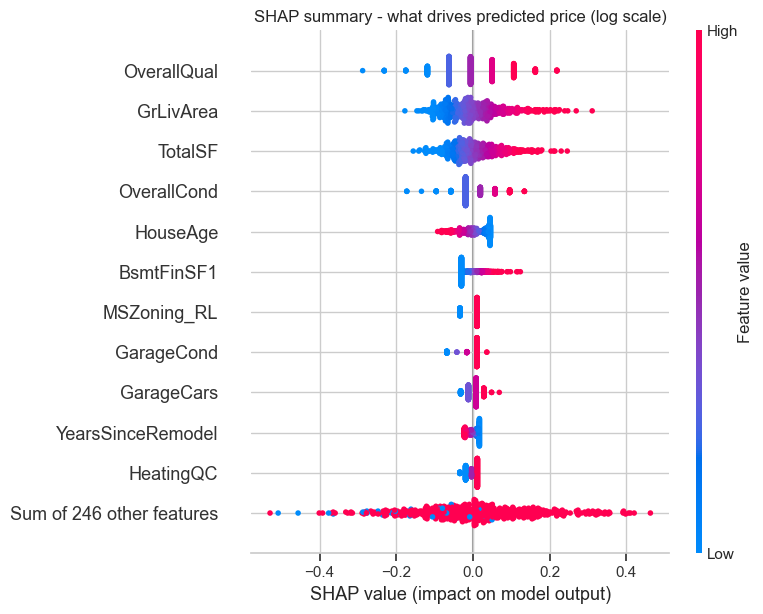
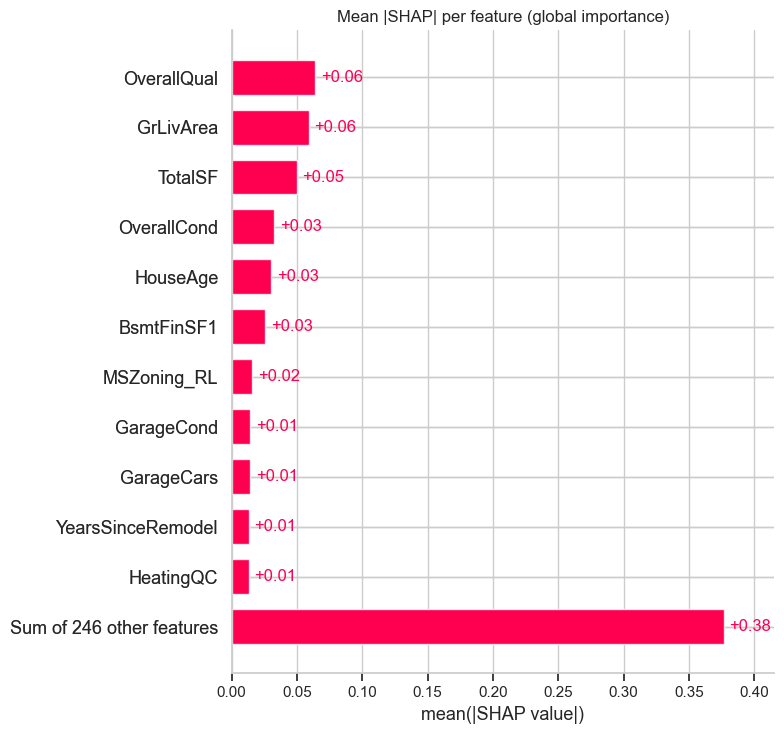
- Best model chosen on cross-validated RMSE / R²; price drivers ranked with SHAP.
- Strength shown
- Clean evaluation and explainable, business-readable drivers.
- Links
- GitHubCase Study
Visual proof
Charts and diagrams are real outputs and architecture from the project.
01Objective
Predict property prices and surface the features that move them, with honest cross-validated evaluation.
02Dataset / input
A tabular housing dataset of property and location attributes with sale price as the target.
03Model approach
- Feature engineering on property and location attributes
- 5-fold cross-validated comparison across regressor families
- SHAP to explain the chosen model
04Results / metrics
Models compared on cross-validated RMSE and R²; SHAP ranks the strongest drivers of predicted price for an interpretable result.
05Deployment / reproducibility
Reproducible notebooks (EDA + modelling).
06Limitations
- Single dataset; prices are market- and time-specific
- No external economic features
07Future improvements
- Geospatial features
- A small prediction UI
08Key takeaway
A well-evaluated regression project that explains its predictions rather than treating the model as a black box.